How to score 1550+ on the SAT in 2026?
A clear, no-BS guide to the digital SAT — what to do, in what order, and why it works. Written by a 1590 scorer.
10 mins read
Last updated January 11, 2025
Overview
Let's be honest for a second. The SAT looks scary mostly because people don't understand it. Not because it's impossible, not because it's only for geniuses, but because most students prepare for it in a very chaotic way. They solve random tests, watch random YouTube videos, and hope that somehow their score will magically go up. That almost never works.
The SAT is not about being "smart." It's about understanding the system and playing by its rules. Once you see those rules clearly, the test becomes predictable. This guide is written exactly for that reason — to show you a clear, logical path from your starting point to a high score. I'm writing this as someone who scored 1590, and everything here is based on what actually works, not on theory.
First Mock
THE FIRST AND NON-NEGOTIABLE STEP:
Take your first full-length SAT mock in Bluebook Simulation Mode."
Before you open any book.
Before you watch any SAT video.
Before you even think about strategies or tips.
Your first action is simple:
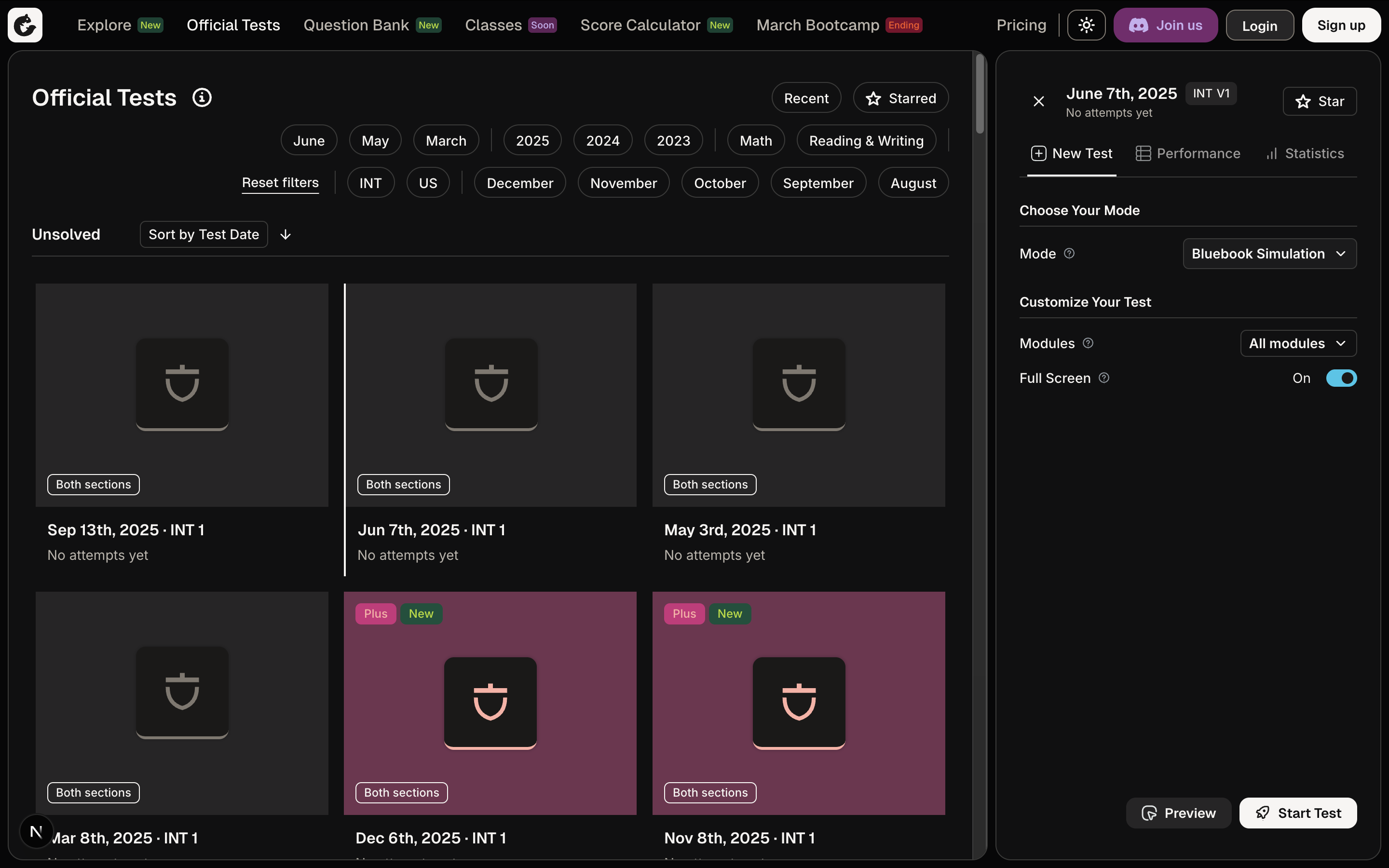
Why? Because the SAT is fully digital. That means the real test looks exactly like Bluebook: same screen, same tools, same calculator, same timing, same adaptive modules. If you don't start here, you're basically preparing for a test that doesn't exist anymore.
Once the Bluebook Simulation Mode is chosen, take a full-length practice test under real exam conditions.
One sitting.
No pauses.
No notes.
No help.
Full screen on.
This test only works if the result is honest.
Using a translator or outside help makes the data useless.
If you’ve reached this point, pause and take your Official Full-Length SAT Test (~2 hours 14 minutes).
This first mock defines your starting point. Everything that follows is built on its Score Report.
Playntest is the single platform where all your SAT decisions are made — what to study, what to skip, and what actually moves your score.
Score Report
THE NEXT NON-NEGOTIABLE STEP:
Use your Score Report to decide what to study — and what to ignore.
After finishing the test, the Bluebook simulation gives you a Score Report. Most students make a huge mistake here. They look at the total score, feel happy or disappointed, and close the app. That's the worst thing you can do.
The total score almost doesn't matter at this stage. What matters is everything underneath it. The Score Report shows you how you performed in different skill areas. Not just "Reading" or "Math," but specific categories. Grammar. Vocabulary in context. Transitions. Linear equations. Word problems. Advanced math.
This is gold because you're not guessing what to study anymore. The test literally tells you: "Here. This is where you're losing points."
You don’t study everything.
You study what the Score Report shows as weak.
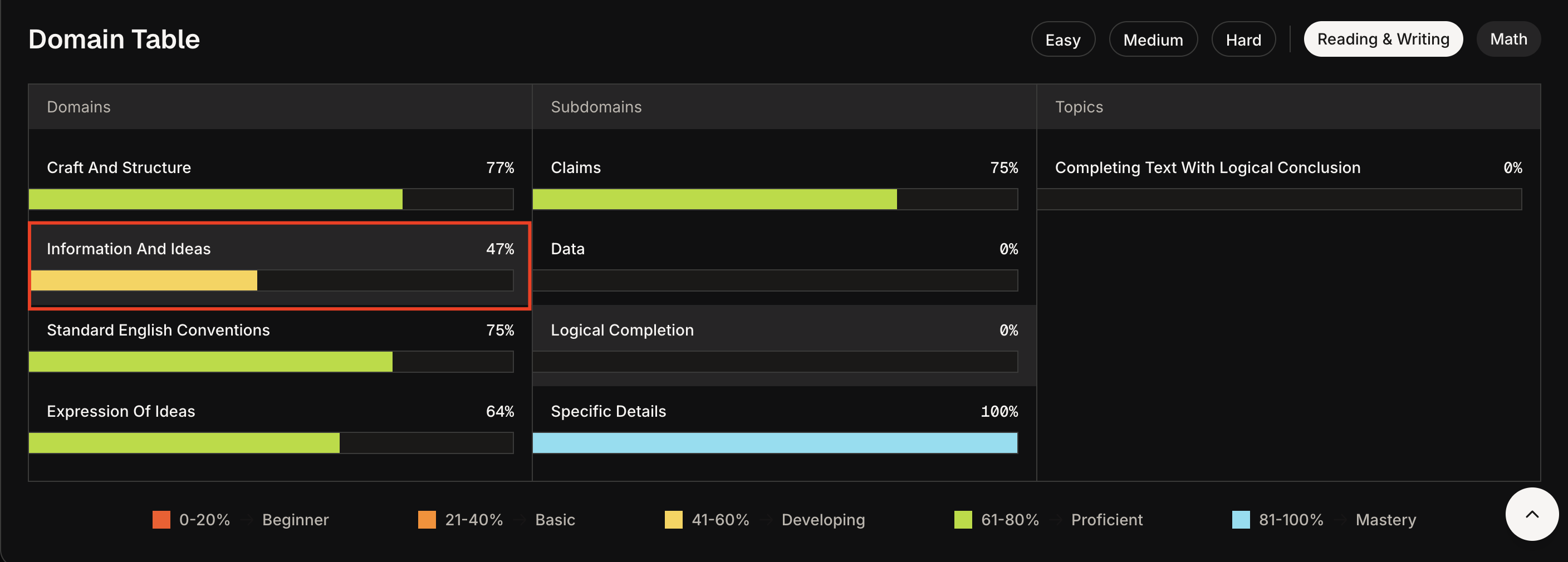
Here, the weakest parts are Information and Ideas Data as well as Logical Completion.
That means your practice should start with Data and Logical Completion — not with random drills or full sections.
Fixing these two areas alone can move your score more than weeks of random practice.
If want to be a more Advanced Test Taker, go one step deeper. Don’t only divide performance by topics — but also divide it by difficulty.
An easy question and a hard question test different skills.
A strategy that works for easy questions often fails on hard ones.
That’s why advanced preparation treats Easy, Medium, and Hard questions as separate categories — each with its own approach.
Verbal Practice Strategy
So let's break down every possible situation:
I. Grammar Approach
If your Score Report shows that Standard English Conventions (grammar) is weak, that's actually good. Grammar is the easiest part of SAT Reading & Writing to improve.
What you must do:
- Go to Khan Academy and open the SAT grammar section. Watch the videos only for the topics you're missing.
- If you prefer books, use Erica Meltzer's grammar book, but don't read it cover to cover — only the chapters you need.
- Do NOT watch or read all the theory, only one topic at a time.
- As soon as you understand a rule, stop.
Immediately go to the Playntest Question Bank, select that exact topic and the appropriate difficulty, and start solving questions. - As soon as you are done with that topic, go to the next one.
Never finish all theory first.
Learn one rule practice it immediately.
Anything else is wasted time.
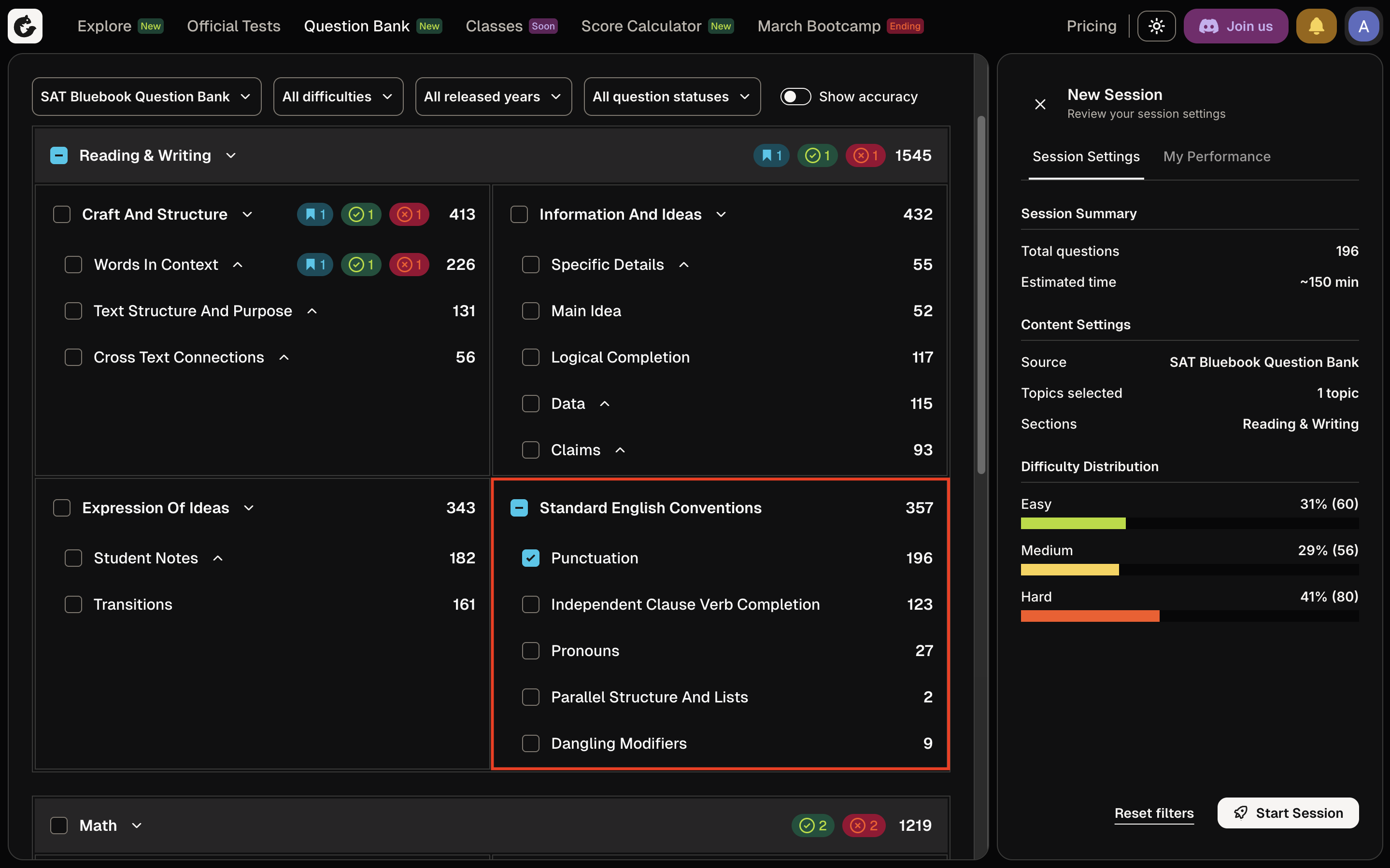
Filter questions by grammar topics and practice them without a timer. When you get something wrong, stop and understand the rule. Don’t rush. Analyzing is the key to 1500+
At this point, your foundation is complete.
If you have:- reviewed the missing grammar topics using Khan Academy or Erica Meltzer, and
- practiced those exact topics in the Playntest Question Bank,...
You also change how you take every Reading & Writing test.
From now on, you will always start the practice test with grammar questions.
On the digital SAT, grammar usually starts around questions 14–16. Scroll there immediately and do those questions first until the 27th one. Every single time. Then go back and do the reading questions.
II. Reading Approach
If your Score Report shows weaknesses in reading passages, information and ideas, rhetoric, or vocabulary in context, the approach is different.
Reading doesn't improve fast. You don't "learn" reading rules. You train it.
What you must do here: Use the SAT Question Bank on playntest and practice reading questions only. Go slow. For every question you miss, go back to the passage and find exactly where the correct answer comes from. Most reading mistakes happen because you assume something that isn't actually written.
Ignore generic reading strategies like skimming or scanning.
Your only task is to prove every answer directly from the text.
The only thing that you need is the approach that you will build by yourself. Maybe it is easier for you to read the conclusion first and then the whole text; you decide that.
Also, don't expect reading to jump quickly. It improves through repetition and review.
Important rule:
Even if reading is your weakest area, you still start every test with grammar. Always grammar first, reading second.
Past papers
Past papers are real SAT exams. Not "SAT-style." Real tests. They are harder than Bluebook and much closer to what you’ll actually see on test day.
The SAT is cyclical. The same ideas come back again and again. Here u can see that:
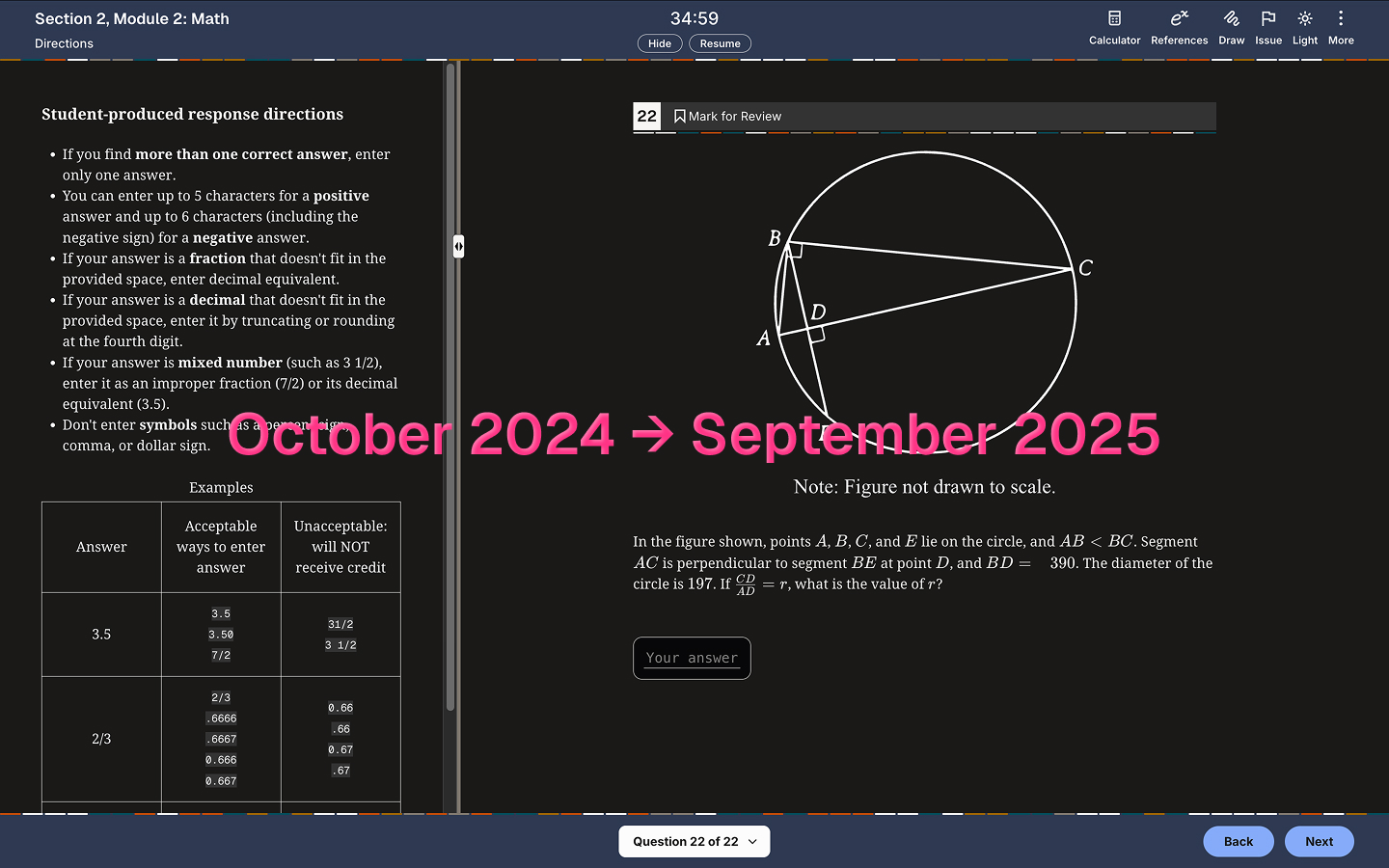
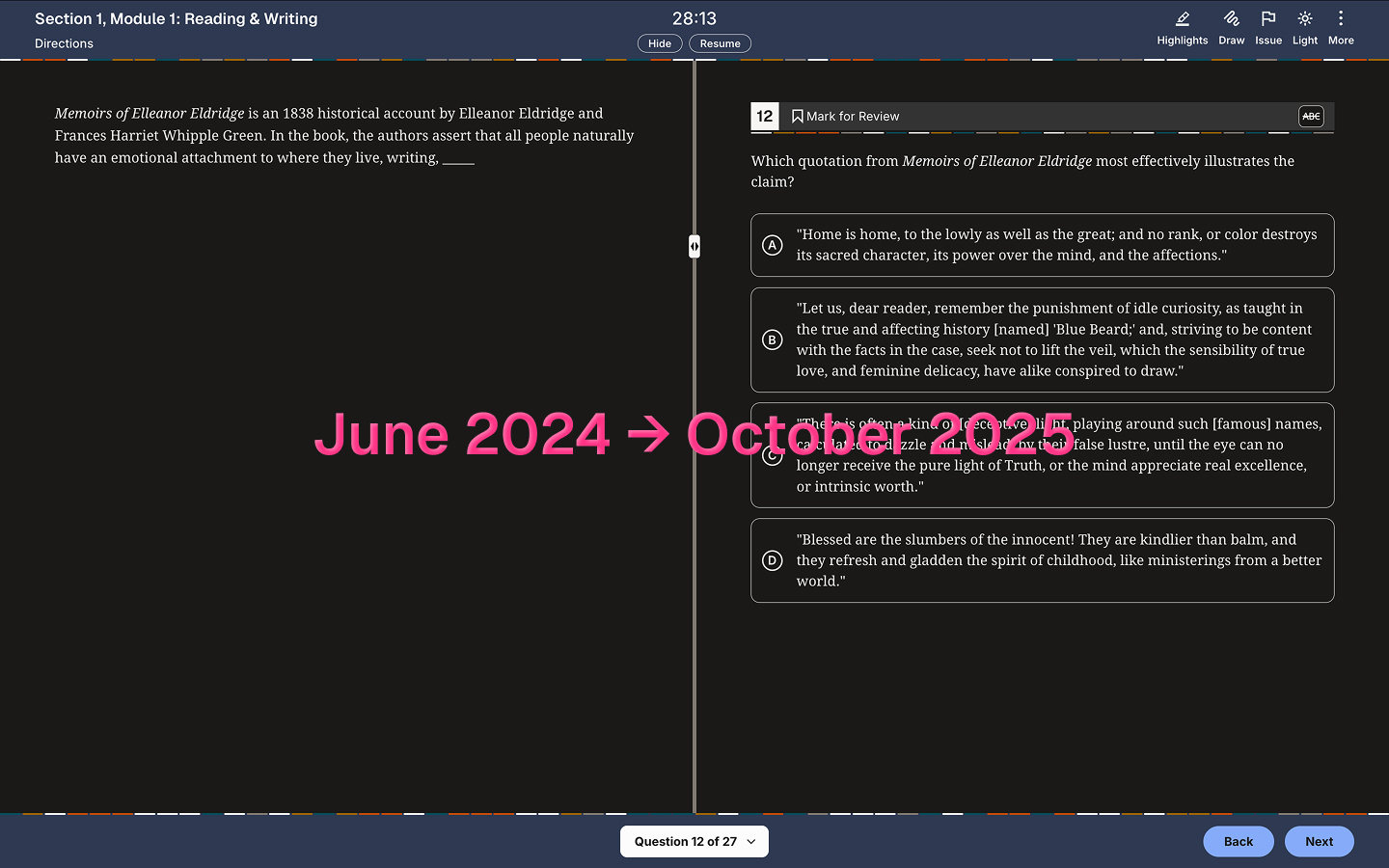
There’s a reason why the average SAT score in China is over 1450. They don’t do magic strategies. They just grind past papers. One, two, sometimes three a day. With full analysis. That’s it. That’s the whole secret. That’s why 1500+ is normal there.
At the top level, improvement comes from repetition.
Past papers are the only tool that consistently move scores toward ~1600.
Here is why Playntest Classes are based on past papers.
Analyze not only wrong questions but also right ones. For instance, when I was preparing, I have always questioned myself: “Why did I answer B, and why is it correct?”
Now let’s break down one question from a past paper:
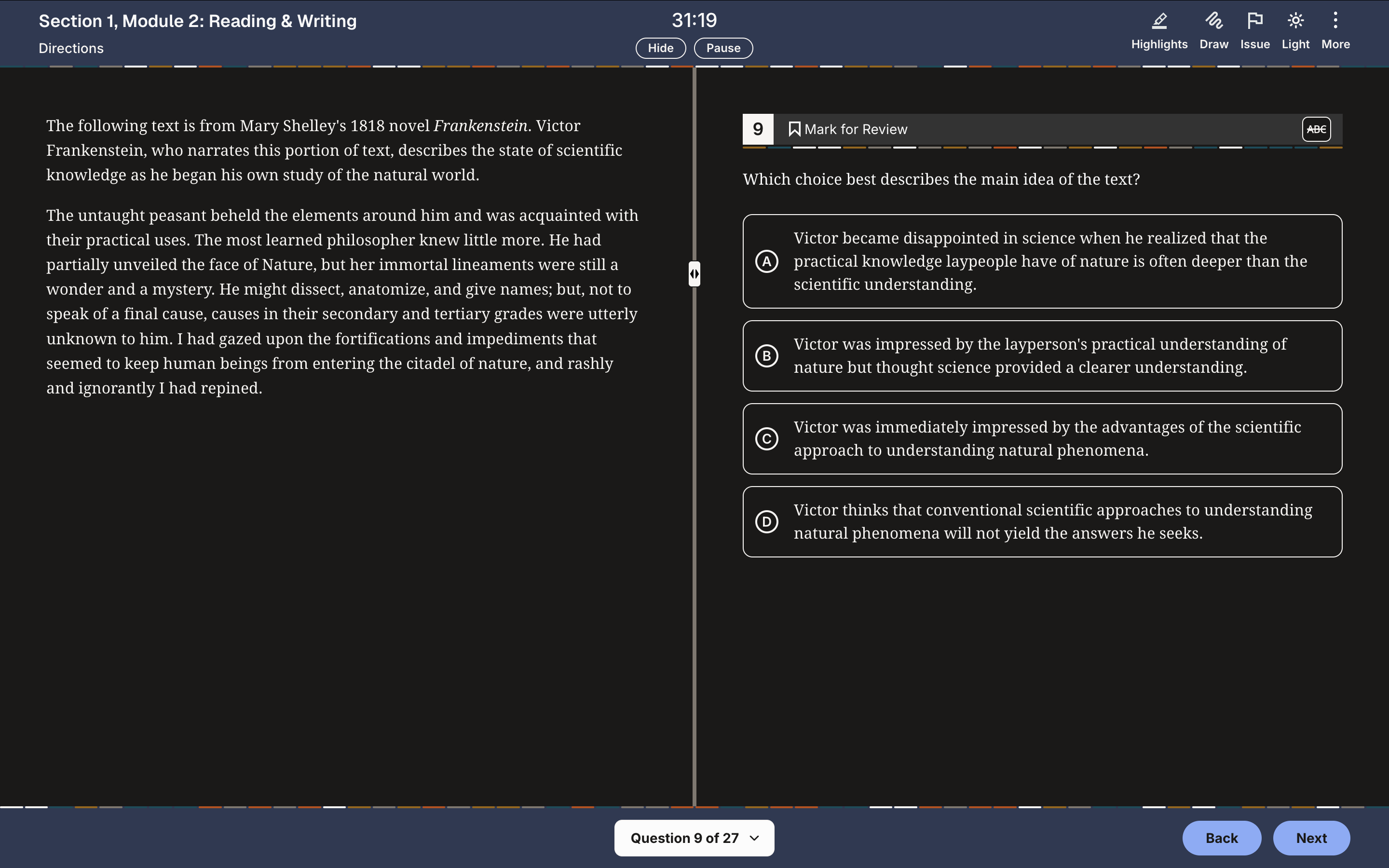
Step 1. Read the context (after reading the question).
Identify who is speaking and in what role.
"Victor describes the state of scientific knowledge as he began his own study of the natural world."
This tells us that Victor is a scientist and the narrator of the passage.
Step 2. Isolate the underlined sentence.
Do not bring in information from later lines.
The underlined sentence:
“he might dissect, anatomise, give names but not to speak of a final cause…”
Who is “he” guys???? WHO IS IT?
Step 3. Track pronouns strictly.
If the passage switches to “I”, the pronoun “he” cannot refer to Victor.
It is not Victor.
We know this because shortly after this sentence, the passage switches to “I,” which clearly refers to Victor as the narrator. Therefore, “he” refers to “the most learned philosopher,” not to Victor himself.
Choice D:
Incorrect.
The underlined sentence is describing philosophers in general, not Victor.
This choice misinterprets the pronoun "he."
Choice C:
Incorrect.
Although the passage later states that the philosopher "knew little more," that idea is not expressed in the underlined sentence itself.
Additionally, "knew little more" means philosophers knew only slightly more than peasants, which is not the focus of the underlined line.
Choice B:
Incorrect.
There is no reference to scientific debate or controversy in the underlined sentence.
This choice is unrelated to the idea being expressed.
Choice A:
Correct.
The sentence explains that final causes and secondary causes cannot be obtained through study.
This implies that what can be gained is something other than a secondary cause, which is exactly what choice A states.
Math Practice Strategy
Math on the SAT is way more structured than it looks.
Almost every mistake in Math comes from one of two things:
- You don't fully understand a topic,
- or you rush and miss a step.
AGAIN, the Score Report tells you exactly which one it is.
When you open your Score Report, don't think "I'm bad at math." Look at which math subskills are weak and fix them one by one.
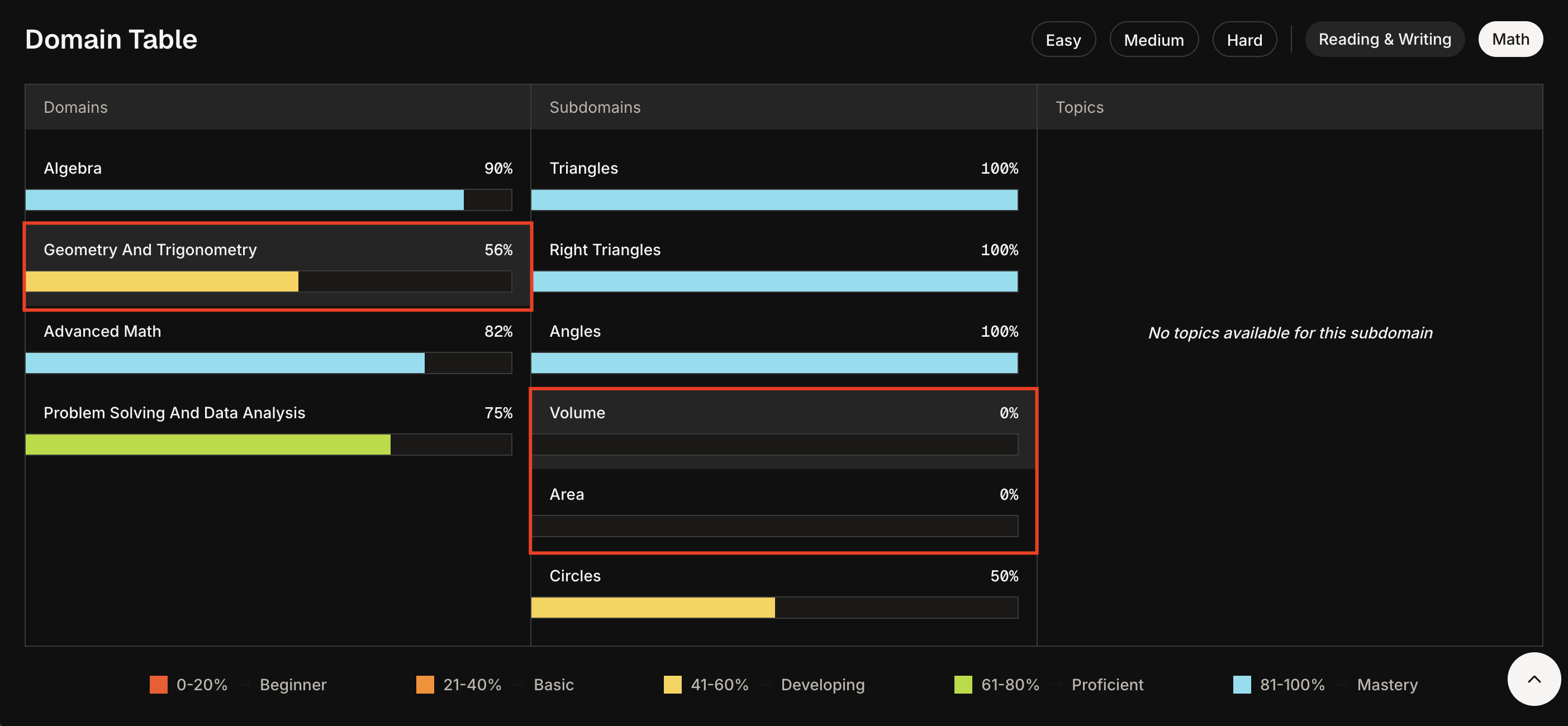
Here, the weakest parts are Volume, Area and Circles.
For SAT Math, the best book to use is PrepPros.
Do not jump between ten resources. PrepPros already explains SAT-style math the right way: clear steps, common traps, and shortcuts that actually work on the test. Also, there is a book of 150 hard problems by Preppros, but this is only for people scoring higher than 650.
You never read the book from start to finish.
You open PrepPros and go only to the chapters that match your weak areas in the Score Report. If linear equations are weak, you study them. If word problems are weak, you study those. Strong topics get skipped.
After reviewing a math topic in PrepPros, you immediately go to the official SAT Question Bank.
What to do there:
Filter questions by the exact topic you just studied.
Solve them without a timer at first.
If you get a question wrong, stop and find out exactly where your logic broke.
Do not just look at the correct answer. You need to understand why your method failed.
This step is what actually raises your score. Reading explanations alone does nothing.
When you take a full Math section in Bluebook, your goal is not speed at first. Your goal is accuracy.
After each test:
Look at every wrong question.
Label it clearly: concept error or careless error.
Concept error → go back to PrepPros → then Question Bank (available on the playntest.com)
Careless error → slow down, double-check steps next time.
Over time, the number of careless errors should go down.
Final Notes
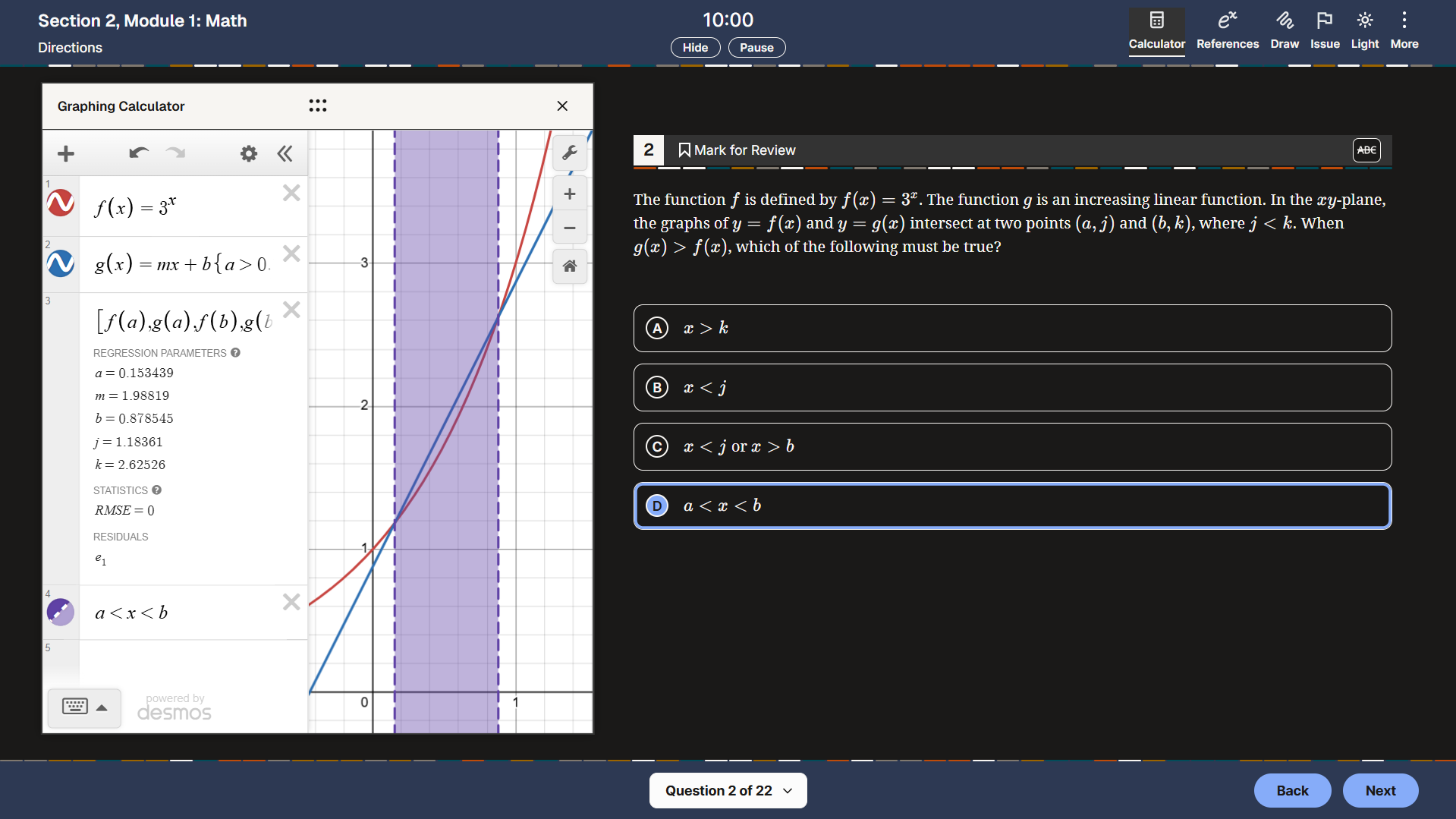
That is what Desmos can DO:
Heyyy, that is all. Good luck! Wish you 1580;)